Tuesday, December 18, 2012

                             Interviewing


    An interview is a discussion between two people in which one questions the other to gain information.  A journalistic interview is a focused conversation between two or more persons to gather information on behalf of an unseen audience. Journalistic interviews are different from regular ones. One reason, is that you need to write things down, and you don't always have a specific purpose. The interview must be formed into something that people will read.

     Before an interview, you must find a good place to interview the person. Also , research the topic you are going to talk about. Think of some questions before hand.
Try to make the interview sound like a typical conversation. Make them feel comfortable when speaking. Aftwerwards, review all your notes.

   It isn't hard to convert the information from the interview to your writing. You must give quotes and tell the reader whom you got the information from.  Also some people would not like you to mention their name, so remeber to listen to the interviewee.
When interviewing , always remeber to avoid awkward silences.

http://www.thefreedictionary.com/Interviewing
http://en.wikipedia.org/wiki/Interview
http://jobsearch.about.com/od/interviewsnetworking/Interviews_Interview_Advice_Tips_and_Techniques.htm

Monday, December 10, 2012

                                         Inverted Pyramid Structure


   The Inverted Pyramid Structure in journalism means to write all your main topics or everything that you are going to talk about, minus the details at the start of your article. In  Inverted Pyramid Structure you state all the crucial information first. And then the less important, and then the least important.  Inverted pyramid structure helps alot when writing articles.
  
    An example of inverted pyramid structure is if you were writing about a baseball game. First you could write about the score and what happened , who was playing against who, who made the winning move. And then you can write about where the game took place. Lastly, you can write about what kind of food was there or the souveneirs they sold there
      I will use the Inverted Pyramid Structure a lot in journalism. It will remind me to stay on topic, always to write the main information FIRST.  You always write the main idea first because you want the reader to know what this article will be about. You want the reader to know what the main idea is right away. The key to holding your audience’s attention is to hit them with a good headline and then fill out the rest of the article with sub-headings to keep them scanning all the way to the end

The inverted pyramid Structure not only an easy and important way for professional journalists to give fast important imformation to their readers but it is also important to my class
 because we could help our classmates with their work and to write better in their own.


http://www.courses.vcu.edu/ENG-jeh/BeginningReporting/Writing/storystructure.htm


Tuesday, December 4, 2012

                 *~*~Bias~*~*

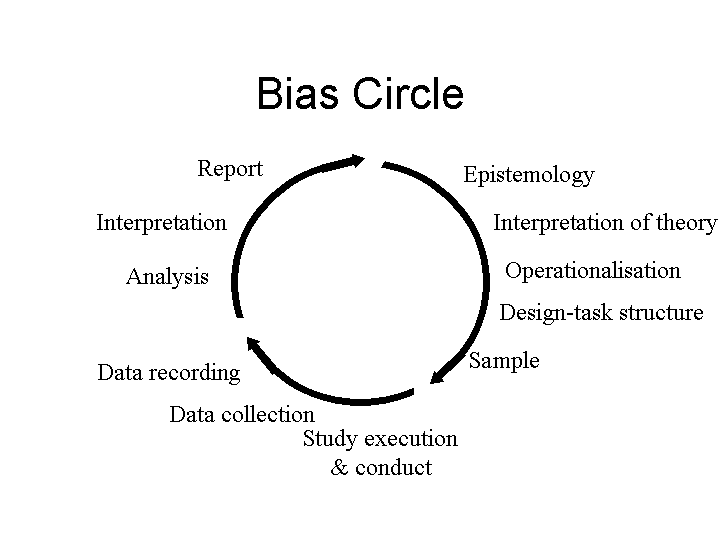
              Bias is an opinion. It's what you think, what you like. Your opinion.  Bias means to take a side and make it seem like it's the better one. Bias is sometimes a good thing sometimes it could be a bad thing.Sometimes journalists include bias in their articles.  Sometimes they just forget. Bias is NOT allowed in Journalism   though. Articles, newspapers, magazines, everything in them should be facts, no bias     
     In Journalism always avoid bias. In Journalism, nobody cares about your opinion, people want facts.
For example, if your friend accused someone of doing something. You can not just take your friend's side because they're your friend. you cant just accuse the victim, you have to find facts.
       Another example, let's say someone broke your window and you suspect it's your neighbor, The annoying little eight year old. You're sure its him because he's always been causing trouble. If your ABSOLUTLY sure, dont write that if you have no proof. If you have proof , you still dont say "I know its him". Say "I think" just in case you're wrong. Write what other people say so that even if it's wrong, you probably won't get in troublebecause you backed up your facts with sources.
      Also, you can't exagherrate, or stretch the truth. There are four types of bias in journalism: Advertising bias, Corporate bias, Mainstream bias, and Sensationalism. To make it beleivable that you're not lying, include as many sorces as possible. write what other people say so that even if it's wrong, you probably won't be punished because you backed up your facts with sources.
Bias is important to this class because it can give readers the wrong idea and we would'nt want that to happen. It can really offend someone and give the everyone who read the article a completely different perspective than they had before. But sometimes we will need some bias to get all of the facts that are needed in the article. I will try to make use of this by sometimes using bias, but including every detail in the story.


Thursday, November 29, 2012

                                              Journalism Integrity

     Journalism Integrity is being a good journalist. Being Honest and fair. Not stretching the truth not lying. Doing whats right.                                                           
       The key elements of journalism integrity is accuracy, avoiding bias, gathering information.  A journalist without integrity is when they are bias and they lie about the facts.  Journalism integrity is important because it teaches the class to be honest and lie or cause conflicts.A journalism may tell lie about politics and spread rumors about celbirties but that means they dont have much integrity . People want truth and facts and a journalist will have integrity and write about true things.

   All newswriters need to verify every piece of information they get. If you find the same thing on two expert sources, it's probably true. You can print that, but maybe not something some preschooler told you. That is most likely not true. The journalism class has to print what's true, not their opinions. Don't bias people who read your paper with the bias you have. Always tell both sides of the story.


"Some editors are failed writers, but the so are most writers."